
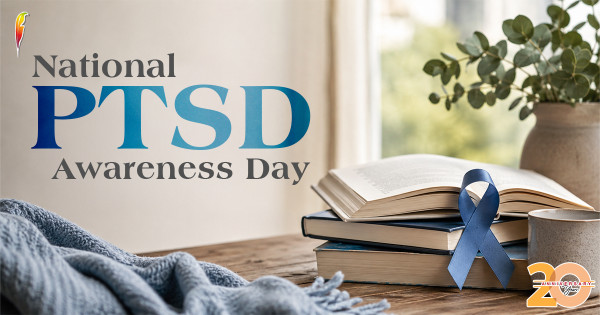
Around 5% of adults in the United States live with PTSD. This is not just a number…these are real people who are trying to sleep, work, love and heal while they carry memories that still haunt them. National PTSD Awareness Day is observed on June 27 and it gives all of us a reminder that trauma is not something visible.
A person might seem calm on the outside and still be fighting all those painful memories on the inside.
People with Post-Traumatic Stress Disorder are often misunderstood rather than being supported.
- Some are told to “move on.”
- Some are called distant, difficult or too sensitive.
- Some stay quiet because they are afraid no one will understand.
But PTSD is not weakness. It can affect both your physical and mental health in everyday life. Books can help us understand this response better. They show what trauma can do to a person’s life and help us support them better.
Why Does this Day Matters so Much?
National PTSD Awareness Day occurs every year on June 27. It is a month we all dedicate to helping more people understand trauma, its symptoms and its triggers.
This day matters because PTSD is still widely misunderstood among people.
Many people think PTSD only affects soldiers or people who have survived some kind of war. Many veterans do live with PTSD but trauma is not just limited to combat. PTSD can affect anyone who has experienced or witnessed something deeply distressing.
What Is PTSD?
PTSD stands for Post-Traumatic Stress Disorder. It is a mental health condition which can develop after a person experiences or witnesses severe trauma.
- For some people, the effects of trauma fades with the passage of time.
- For others, the mind and body continue reacting as if the danger is still there.
A person with PTSD may know they are safe now, but their body may still respond as if something bad is about to happen. That is why PTSD is still confusing for the person living with it and also for the people around them. To understand PTSD, you have to understand that trauma can stay in the nervous system even after that particular event has ended. It is not about being weak. It is about the mind and body trying to protect a person after something overwhelming happens.
What Are the Symptoms of PTSD?
The symptoms of PTSD can be visible within days but sometimes they can also show up months or even years later. Some people know exactly what they are reacting to…There are others who feel anxious or angry without even knowing what they are reacting to.
Common symptoms of PTSD include:
Memories of the traumatic event
Nightmares or disturbed sleep
Flashbacks that make the person feel as if the event is happening again
Avoiding places, people or conversations linked to the trauma
Feeling emotionally numb
Panic-like reactions when reminded of the trauma
PTSD can also affect the body.
A person might feel his/her heartbeat racing, sweating, headache or stomach pain when something reminds them of that trauma. These symptoms are not attention-seeking or overreactions.
They are signs that the mind and body are still trying to deal with something overwhelming.
The Four Types of PTSD Symptoms
PTSD symptoms are often grouped into four main types. Understanding these four types can make the condition easier to recognize.
1. Intrusive Memories
2. Avoidance
3. Negative Changes in Mood and Thinking
4. Changes in Physical and Emotional Reactions
How Books Can Help Us Understand PTSD
Books cannot replace therapy and they cannot diagnose or treat PTSD patients.
But they do open a door...They can help readers understand what trauma feels like from the inside. They can also show how people survive through pain which helps them understand PTSD better. This National PTSD Awareness Day 2026...Let's make reading a small way to learn and understand better.
10 Books That Help Us Understand Trauma & Mental Health
Here are 10 books from Austin Macauley Publishers that will help you understand trauma a lot better.
1. Notes from a Stressed-out Teen by Noah Grant Sanz
Noah Grant Sanz In his book talks about what it feels like to be a teenager with too much going on. He talks about school pressure, heartbreak and the thoughts young people often keep to themselves.
This book is a good choice for readers who want something honest and close to teenage life.
2. A Thousand Cuts by Sweden De Matas
A U.S. Army family tries to live with the damage left behind by war. In this book we see PTSD and military discharge from a child’s perspective.
This title brings family trauma and military life into one emotional story.
3. Mental Health Matters – Volume 2 by Natalie Ann Hughes
Natalie Ann Hughes uses poems to write about mental health and the kind of difficult days people do not always talk about. The poems feel personal and easy to relate with.
This book is suitable for readers looking for an honest take about emotional struggles.
Dan Dale shares his own experience of living with bipolar disorder and memories from a difficult childhood. He writes about what it feels like when your condition is not understood by others.
This book gives readers a look at mental health and the need to speak openly about it.
5. Poetry for the Hungry by Denise Le’Anne
Denise Le’Anne writes about abuse, emotional pain and finding the strength to speak again. The poems look at moments where people feel hurt or unheard completely.
This collection is a fitting choice for readers who relate with poetry about healing and personal strength.
6. Descend into Darkness by Filip Hozak
Filip Hozak writes about his own experience of depression and the years he spent living with it. The book shows how someone can seem fine to others while struggling deeply inside.
This title gives readers a direct look at depression and the need for more understanding.
7. The Importance of Rest by Natalie Moore
Natalie Moore shares how her life changed after being diagnosed with chronic fatigue syndrome/M.E. at 21. She writes about illness, recovery and learning to live at a slower pace.
This book is a good choice for readers interested in stories about health and rebuilding life.
8. The Resilience Mindset by Robert Hall
Robert Hall writes about how people deal with stress in life. He looks at the way our thoughts and choices can affect how we move forward with our daily chores.
This book is for readers who want to understand resilience in a simple and practical way.
9. Anxiety, It’s Time to Go by Kevin Mullin
Kevin Mullin explains anxiety in a way that is easy to understand. The book gives simple steps for people who want to manage anxious thoughts and feel more in control.
This title is a helpful pick for readers looking for a clear book about anxiety.
10. Life and Death by Beth Montgomery
Beth Montgomery shares stories of her nursing experience and how she managed to help people even during difficult moments. The book shows the emotional side of healthcare that many people do not see.
This title adds a real look on the life at hospitals and the people who work through it.
What People with PTSD Want Others to Understand
Many people living with PTSD do not want pity. They just want people to understand.
They want people to know that:
They are not trying to be difficult
Their triggers are not made up
Healing will take time
Some days are harder than others
Trauma can affect the body as well as the mind
How to Support Someone with PTSD
You do not need to have to choose the perfect words to help someone with PTSD. Most of the time, people just need a little patience, safety and understanding that’s all.
Here are a few simple ways to help:
Listen without forcing them to explain
Let them share everything at their own pace. Do not push for details. Trauma is not easy to talk about.
Believe them
You may not understand their reaction, but that does not mean it is not real.
Avoid saying “just move on”
Healing is not that simple. PTSD is not a choice.
Ask what helps
Some people need space. Some need company. Asking is always better than assuming.
Be patient with changes
PTSD can affect mood, energy, sleep, trust and communication. Try not to take every reaction personally.
Some Final Thoughts
National PTSD Awareness Day is more than just a date on the calendar. It is a reminder for everyone to listen better and judge less. PTSD is often invisible, but its effects are real.
It can change how a person sleeps, reacts, remembers and handles his/her daily chores.
But awareness can help.
- It can help people understand the symptoms of PTSD.
- It can help families recognize the signs of complex PTSD.
- It can help survivors feel less ashamed.
- It can help more people ask for help.
And sometimes, books can help us understand everything better.
They give words to pain. This June 27…let National PTSD Awareness Day be a reason to learn and listen without judging anyone. Because behind every trauma response is a person who deserves safety and hope.
We use cookies on this site to enhance your user experience and for marketing purposes.
By clicking any link on this page you are giving your consent for us to set cookies


 Discover