Book Description
Embark on a captivating journey across the vast Russian steppe aboard the iconic Trans-Siberian Railway in this modern tale of self-discovery and introspection. The narrator, known only as D, begins his westward voyage in Vladivostok, traversing the ever-changing landscapes that unfold before him. As time moves inexorably onward, the everyday lives of the passengers intertwine with the rhythmic churning of the train’s propellers, contrasting sharply with the raw silence of the natural world beyond the windows.As the journey progresses, D’s physical expedition takes an unexpected turn, delving into the depths of his own psyche. A haunting presence, N, permeates the narrative, her essence imbued in the natural world, particularly at the breathtaking Lake Baikal in Siberia. N represents the one who got away, leaving a void and a profound fragility within D’s soul, scattering her ghostly influence across the many places his footsteps tread.Immersed in the tranquil vistas of the external world, D finds himself enamoured by the everyday characters he encounters along the way. As he navigates the complexities of his inner turmoil and the beauty of his surroundings, the narrator embarks on a transformative odyssey. The D who began his journey in Vladivostok will inevitably be different from the one who arrives in Moscow at journey’s end, but what will this transformation entail? Join D on this introspective voyage as he unravels the mysteries of his past, present, and future on the Trans-Siberian Railway.
He is a man of solitude. His world is that of the quiet and distilled. Each night, he sits at his desk as the clock strikes midnight. He journeys inward to that bottomless pit of conflict, prompted by memory, in search of an image fused with the imagination in order to reveal truth through character and the creative narrative process. The words become sentences and they are formed. And so it all begins. This was his first attempt and successful completion of a full-length book. His name is Daniel C.A. Christianson.
Available On These Platforms
Customer
Reviews
117 reviews
-
I am not sure what to think about this book. I read a lot of travel books and I do know what kind of narrative I am drawn to. In most travel books I have read the reader is brought into a world and on a journey of that particular place by the narrator. The reader very much becomes part of the environment in which the story is set. We get to experience what the narrator has also experienced and by the end we do know that environment like we know our own environment at home. East to West is not that kind of book. It was not written in the way that I had expected it to be written but still there was something original and pure about this book. The reader is brought into the mind and soul of the protagonist D and in the beginning it does feel like another travel book but then the internal musings and traumas of the narrator begin to be revealed layer by layer and nothing remains hidden. It is as though the narrator decided to remove all the chains around his neck and create something that is very raw and visceral. At times the narration is quite explosive with a certain anger behind those words while at other times there is such a gentleness and sensitivity with the words that the narrator uses. It is obvious that the natural environment and mammoth size of Russia plays a significant role because it needed a setting and place as vast as Russia to be able to slowly show the full introspection of the narrator. It is very clear that the protagonist D has a great admiration and love for Russia and specifically its period of flourishing and renaissance in old Rus. Perhaps his lost love N is Russian and he searches for her in such a vast space because the love they once had is comparable to such a vast and beautiful setting like that of lake baikal in siberia.
-
Thoroughly enjoyable read.
The author takes you by the hand and gives you a vivid guided tour of the journey. He also immerses you in his inner journey and gives you an honest uncensored account of his life and his lost love. Highly recommended.
-
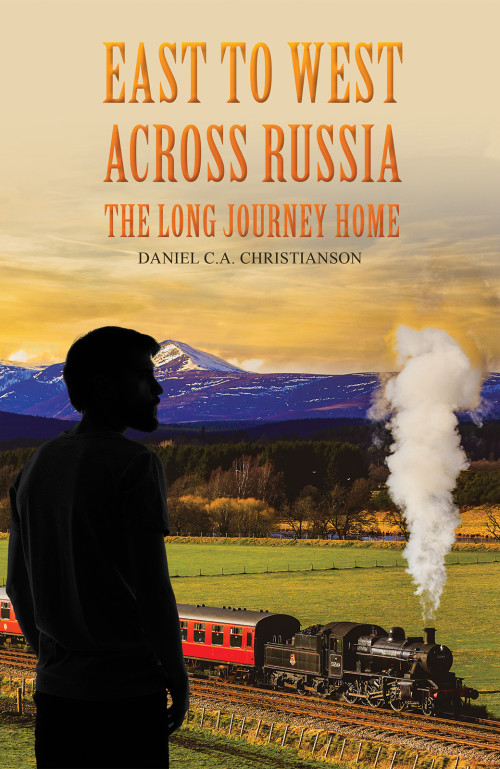
I read this book recently on the recommendation of a colleague of mine. I have always loved travel tales but this story across Russia is a very different one to other travel tales. The first thing that I found strange but also compelling is how the author mentioned that it is a book of both fiction and non fiction. I have not read many books like this before. I can only assume the fictional narratives relate to the mysterious character named N whom we never hear from and who only briefly makes an appearance on the heated cobblestones of Red Square in the final scene. The protagonist D is also quite an elusive character, deeply introspective and filled with melancholia, pining for his lost love whom he would wait for a 100 years in kirov park if he knew that she would return to him and their love. The author is also filled with mystery. His biography is short, written in the third person and only reveals his internal thoughts. We don't know anything about him. I was told that he is a Swedish man living in Ireland. There is no image of him inside the book and only a silhouette of a man standing outside of a train looking far away into the Russian landscape. Everything about this book is a mystery but that is probably the story and history of Russia. It has always been full of mystery. This book was very different to what I had expected but I am happy that I went into the story and along for a very turbulent ride across Russia along the transsiberian railway.
-
One of the many dreams that I have is to ride the rails of the transsiberian railway across Russia. This dream has occupied my mind and plagued my spirit ever since I was a young girl and when I first read the words of Boris Pasternak. There is something so enigmatic about Russia. Of course its size is colossal taking up so much of planet Earth but equally so is Russia's blood stained history and most of all is its glorious literature on which so many stories, imagined and real became a part of life of this great culture. I don't know when I will be able to fulfill this dream of mine with this ongoing conflict but I hope one day to follow the same path that Christianson made from East to West, from Vladivostok all the way on land to Moscow. When I was reading his story and experiencing his narrative of D I felt that I was on those trains and gazing out at the natural and changing landscapes. I can only imagine what it feels like to stand on the shores of Lake Baikal and look upon something that has lived for millions of years. The story of D&N is a very mysterious one. I don't know if it was a real love story but even if it is only a fictional love story it is filled with passion, longing and ultimately the death of the love that once promised so much. I am convinced that no story set in or about Russia is a bad one. Russia fills the writer with so much energy that leads to the creation of such beautiful and poignant words. I didn't want the end of this novel to come. Instead, I wanted to go back to the beginning at Vladivostok station and begin this story all over again on this wonderful journey across Russia.
-
Fascinating read. It brings to life the train journey across Russia. I have not been to Russia but after reading East to West across Russia I feel I have. It is such a gripping book it leaves a strong desire to do the trip. Maybe when the political scene improve it would be fascinating to sit on the shores of Lake Baikal in Siberia as D did.
I believe N is a real person and is D's lost love that he would like to rekindle.
Daniel C.A Christianson...you are now a writer.
Looking forward to your next book.
-
I read this delightful but deeply personal novel a few months ago. I thought that I had a good understanding of the meaning of Christianson's memoir but then last week I read the interview of Christianson with Brian Feinblum, a book publicist from the United States. In the interview Mr Feinblum asks Christianson ten individual questions relating to his novel and to his writing in general. Question 4 really intrigued me where Feinblum asked Christianson about how he decided on the title for his book and its cover design. Christianson's response was very revealing as he stated that above the smoke coming from the moving train one can see the faint outline of a human face. I certainly had not noticed this human face before although it is very faint indeed. However, on closer inspection one can make out a human face and the author stated to Feinblum that this faint outline of a human face is none other than the protagonist's lost love N. This now makes me believe that the character N is a real person. From my close reading of East to West I had come to the conclusion that N could not be a real person but an entity that is not of this world. N represents a utopia figure and a place that D longs to reach one day. I am now wondering if N is a real woman and the lost love of D? If this is so then who is this woman named N? Why didn't the author name her? Why did the author not even name his protagonist? Can we now assume that D is indeed the author Daniel C.A. Christianson or is D an idealised figure too? It still leaves so many questions that are difficult to answer but I really enjoyed this novel. It forced me to look inside my own soul and question how I live my life.
-
At the heart of this narrative is a novel of existentialism as the author through his protagonist D is depicting a way of life that he wants to inhabit but is stunted in the present by the everyday chaos of modernity. He never mentioned the prominent proponents of existentialism such as Soren Kierkegaard, Jean-Paul Sartre, Albert Camus, Friedrich Nietzsche although he did briefly refer to Simone de Beauvoir in kirova park when the protagonist was critiquing man's dominance over and abuse of the female species. The subject of philosophy and existentialism is crucial to the entire narrative and its overall meaning as the protagonist from the very moment he steps onto the soil of Russia is contemplating on his own existence and slowly overtime he begins to look internally where all the flaws and fallibilities of his own humanity are laid bare for him to see. The character D connects deeply to the Russian writers from the 19th century and more specifically Chekov, Dostoevsky and Tolstoy who in many ways were very much existential writers and certainly Dostoevsky lived that existential meaning through his dark and poignant narratives. The existential philosophers that the author of this novel clearly admires encouraged people to find their own meaning and values in a world full of contradictions and depravity. The protagonist D as he moves through the vast terrain of Russia is slowly becoming that existential philosopher as he grapples with his own life and especially the loss of his great love N. I don't think the character N is a real life woman but like many others have said she is an idealized heroine type figure that D is traumatized by her departure but in reality D is traumatized by the utter absurdity of life and so he desperately tries to find a grand meaning to his life. In the end the meaning for D is through his writing. He must write in order to fully exist as a person.
-
Fabulous images of Russia are translated in the written word. I feel the journey on the train. To the experience in the restaurant eating the local cuisine. Can’t wait for the next book
Write a Review










 Discover