
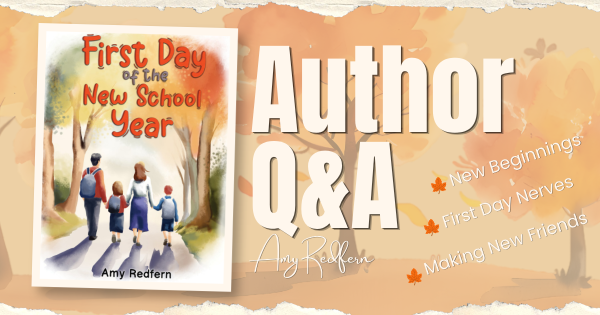
With the new school year just around the corner, we’re delighted to chat to the author of First Day of the New School Year about the inspiration behind Louise’s story.
Drawing on years of experience as a primary school teacher, the author captures the excitement, nerves, and little worries that can make a new school year feel like a very big adventure. In our Q&A, we explore the story’s message about managing change, finding courage, and discovering that you’re never alone in feeling a little nervous.
If you know of any little ones about to venture on their own journey who would love a little reassurance, Grab your copy of First Day of the New School Year!
The first day of school is a daunting and relatable prospect, and Any Redfern's First Day of the New School Year is here to help children face that day with confidence and empathy. The experiences of a former teacher shine through here, offering a perspective that will delight young reading with charming illustrations and a gentle prose that is perfect to be read the night before the big day. This book is a reminder that everyone feels nervous, and that we all face the same challenges, but they can be overcome with a smile and there was never any reason to be worried about the first day of school.
⭐⭐⭐⭐⭐
Richard Blackwood
What inspired you to write First Day of the New School Year, and where did Louise’s story begin for you?
The idea really came from my years as a primary school teacher. Every September I saw the same mixture of excitement and anxiety in children coming back to school. Even children who knew the school could worry about a new classroom, a new teacher, where they would sit or whether their friends would still be there. I wanted to capture all those little worries that can feel enormous when you’re a child. Louise grew from those experiences. She isn’t based on one particular child; she represents lots of children I taught over the years and from my own experience/ nerves of having a new class!
The first day at a new school can bring both excitement and anxiety. What do you hope children take away from Louise’s experience?
More than anything, I want children to realise that being nervous is completely normal. Louise worries about everything from her clothes and what other children might think of her to whether she has remembered everything she needs. But when she gets to school, she discovers something important, she isn’t the only one feeling that way. I hope a child reading the story thinks, “Louise feels like I do, so perhaps I’m going to be okay too.” The worries don’t have to disappear before you do something; sometimes you discover you can cope by simply taking that first step.
Did writing this story bring back any memories of your own experiences of starting somewhere new?
It actually brought back more memories of being a teacher than of being a child. After thirty years in primary education, I can still remember those first mornings in September, new faces, new uniforms, parents at the gate and children trying very hard to look confident when you could often see that they were nervous underneath. And teachers have first-day nerves too! Every new class is a fresh start for everyone. I think that is why I wanted the story to show that nervousness isn’t something children need to be embarrassed about.
Why do you think starting a new school year can feel so daunting for children, even when they’re excited about it too?
I think it’s the uncertainty. Children often cope much better when they know what is going to happen, but a new school year contains lots of unknowns. Who will my teacher be? Where will I sit? Will the work be harder? Will my friends be in my class? What if I do something wrong? Individually those worries might seem quite small to an adult but put them all together and they can become overwhelming. That’s why Louise’s thoughts jump from one worry to another even wondering whether people will laugh at her new school clothes.
Louise encounters new teachers, classmates and unfamiliar situations. Which part of her journey do you think children will relate to most?
Probably the build-up before she actually gets into the classroom. There isn’t one enormous thing frightening Louise; it’s all the little things. She can’t sleep, she worries about her clothes, she has butterflies and she checks that she hasn’t forgotten anything. Those are very ordinary experiences, which is exactly why I think children will recognise themselves in her. But my favourite moment in terms of reassurance is when she sees her friends and realises that they look nervous too. Suddenly she isn’t alone in what she is feeling.
What was the most enjoyable, or perhaps most challenging part of writing the story? Was there a particular scene you especially enjoyed bringing to life?
I enjoyed turning Louise’s worries into things children could immediately recognise. Something like “butterflies in my tummy” is such a familiar expression, but to a child it describes a very real physical feeling. I also loved the moment when Louise finally reaches her classroom. Throughout the story we have been inside her head, hearing everything she is frightened might happen. Then at the end we discover that Louise is actually the teacher. I particularly enjoyed that reveal because it changes the way you look back at the whole story. Adults get nervous too!
If you could give Louise one piece of advice before she walks through the school gates on her first day, what would it be?
I’d probably tell her exactly what she tells herself: take a deep breath and smile. You don’t have to know exactly how the day is going to go. Give yourself permission to feel nervous, walk through the door and take things one moment at a time. Quite often the thing we have imagined is much more frightening than the reality.
Beyond the story itself, what do you hope First Day of the New School Year will help children feel more confident about?
I hope it helps children become more confident about change itself. Starting a new class is only one of many new beginnings they will experience. There will always be times when they don’t know exactly what to expect. I’d like them to understand that feeling nervous doesn’t mean they aren’t brave or capable. You can have butterflies in your tummy and still walk through the door. And sometimes, once you do, you discover that the thing you were worrying about might actually turn into something wonderful.
We use cookies on this site to enhance your user experience and for marketing purposes.
By clicking any link on this page you are giving your consent for us to set cookies



 Discover